Belief
Rituals, Gods and the People Who Came
A fertility cult addressed to the Great Mother Goddess, a sun that conferred the right to rule, and the warrior peoples who later held this ground.
Kokino has a double life. Some of the markers cut into the rock were practical instruments for tracking time and the seasons. Others, together with the stone thrones and the rock itself, were religious. As a sanctuary it seems to have been a regional centre — people walked up to two days on foot to perform their rites here.
The Great Mother Goddess
For the people living around Kokino in the Bronze Age, as for many of their contemporaries, the elements were alive — they had characters and moods. Archaeologists believe two principal cults were practised on the site, addressed to two deities worshipped in one form or another across many Bronze Age cultures: the Great Mother Goddess, and the Sun.
The Great Mother Goddess was the personification of growth — of the fertile earth that bore the crops, fed the animals and sustained the people who lived from it. Kokino's rocks are volcanic, and so are riddled with horizontal and vertical fissures. The people living nearby understood those cracks as openings into the womb of the Goddess.
Into them they laid gifts brought from their homes: vessels full of fruit and vegetables, liquid offerings, figurines, grain mills, pyramidal weights, moulds for casting bronze. Once laid, the offerings were buried under earth and stone. The gifts were meant to win the Goddess over, so that she would grant a fertile season.
The small votive figurines — parts of the human body, and domestic animals — were intended to secure good health for people and livestock alike.
The Sun and the thrones
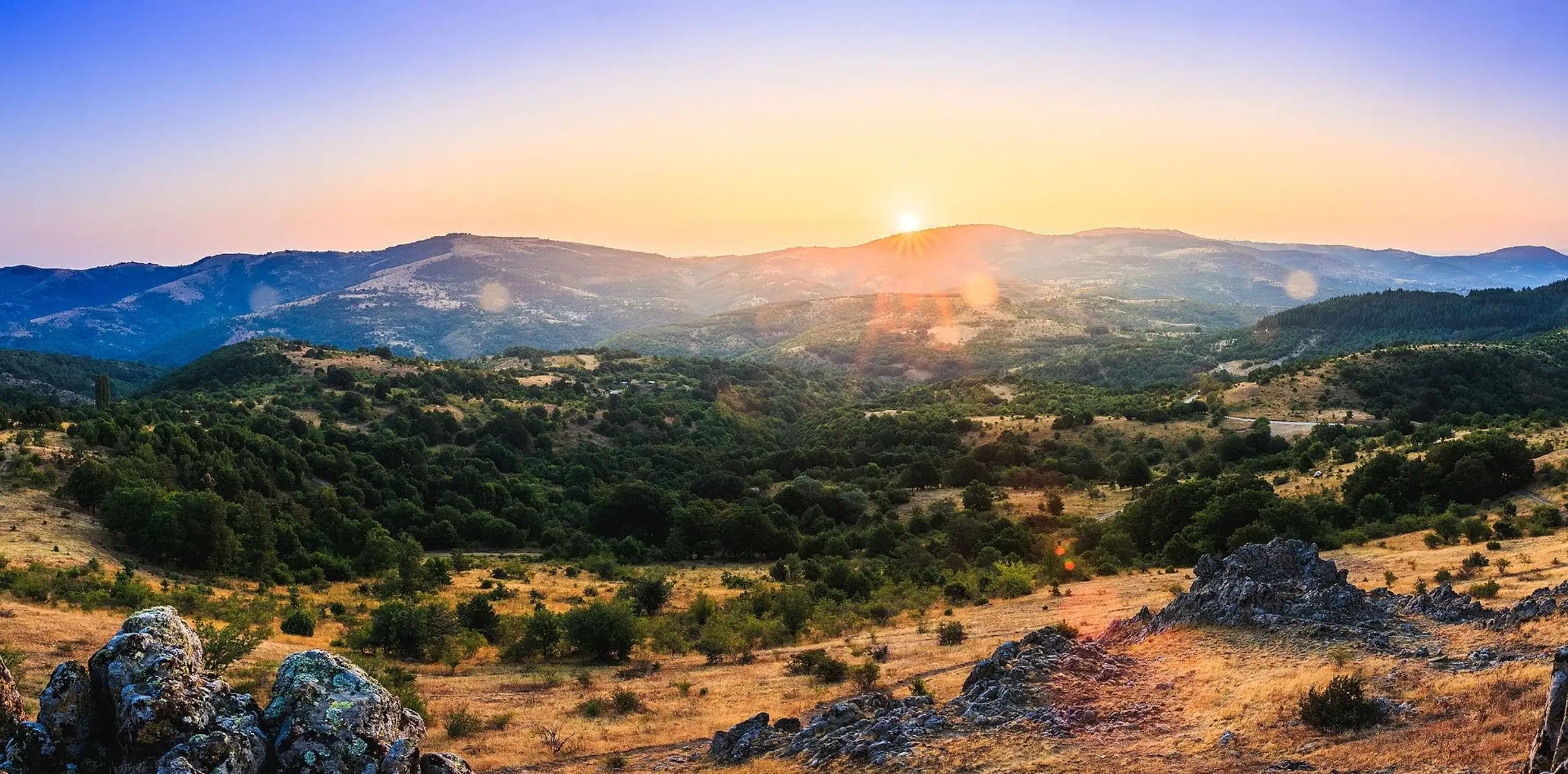
The second rite concerned the deity of the Sun. Considered the son of the Great Mother Goddess, the Sun stood for light, strength, power and warmth. Archaeologists hold that the thrones at Kokino were carved precisely to transfer that symbolic power — and the right to rule over the tribe. Those who sat on them faced east.
The sun then rises on the eastern horizon and lights first the person on one throne, and only afterwards all the others — conferring legitimacy and strength on the elder or priest to rule over his people. The power of the sun passes to the person the light falls on.
The ritual marker K
The most remarkable of all the alignments is the ritual marker (K), watched by an observer seated on one of the thrones. It lies just below the highest part of the site. The sun appears on it on certain days of the year: the rays pass the right-hand edge of the artificially cut trench that borders Platform B from the west, then through a second worked marker, and light one single stone seat on Platform A.
Marker K is also a second equinox marker — further proof that Kokino's builders understood the concept. Observed from Platform D, it doubles as the marker for Aldebaran, because in the 21st century BC (about 2083 BC) that star stood at the equinox point.
At the start of the second millennium BC, the heliacal rising of Aldebaran in mid-May — seen through the equinox marker from Platform D — and the sunrise through the ritual marker K, seen from the platform with the thrones, happened on the same morning. Because both markers are worked into the same block of stone, K is a shared, “double” marker for Platforms A and D at once.
The lighting of a throne, and the appearance of Aldebaran and the sun on the double marker, were probably watched as part of celebrations marking the start of new seasons — the renewal of nature, and the new cycles of farming and herding on which the community's survival depended.
The peoples who came after
Kokino and its surroundings were continuously inhabited from the beginning of the Bronze Age. Of some of these peoples — the builders of the observatory and the sanctuary — we can only guess how they lived, for lack of a written language and the limited number of artefacts they left. Of others, history preserved texts and traditions.
In the Iron Age and antiquity, the territory of what is now North Macedonia was settled by the Paionians, a people sung of in Homer's Iliad. Famed as horsemen, they fought on the Trojan side; their skill as riders later saw them recruited into Greek and then Roman armies as heavy cavalry.
Fewer visitors know that the land this observatory overlooks was home, in the time of Alexander the Great, to one of the most formidable peoples in the region — the Agrianes. A Paionian tribe, they were known for their skill with the javelin and their discipline as a unit. To keep their speed they carried a bundle of javelins and little else: no armour, no helmets, perhaps not even shields. They excelled on difficult ground, where a phalanx was impractical and mobility mattered more.
Visit on one of these days, at the height of the elements' power, and you may find yourself carried — for a moment at least — into the legendary past of this place, when the living gods still walked our earth.